
How often should you deep clean your home? The answer depends less on a date on the calendar than on how your household uses each room. A home with pets, young children or frequent visitors may need more attention in high-use areas than a quieter household. If intensive cleaning keeps slipping off your to-do list, a rigid schedule can become one more source of stress.
Deep cleaning is different from everyday tidying and wiping frequently used surfaces. It gives more attention to areas that routine cleaning tends to miss, such as grout, appliance interiors and door frames. A full-home deep clean every three to six months is a common starting point, but you can adjust the timing to suit your home.
This guide will help you choose a realistic schedule, identify signs that an area needs attention sooner, and break the work into manageable tasks. You’ll also see how regular upkeep differs from a one-time deep clean, and how professional one-time or weekly cleaning can help make home maintenance easier.
Key Takeaways
- Set your deep-cleaning rhythm around how often each space is used, rather than following a calendar rule that may not suit your household.
- To decide how often should you deep clean your home, consider household activity, cooking habits, pets and areas that are easy to overlook.
- Prioritise areas where grime returns or routine cleaning falls short, then spread less urgent tasks across the year.
- Keep routine upkeep separate from a more thorough reset. Regular cleaning helps maintain the home, but may not cover deeper tasks.
- Consider a one-time professional clean when tasks have accumulated, or weekly cleaning for ongoing upkeep.
How often should you deep clean your home? Start with the right baseline
How often should you deep clean your home? Let household activity, your usual cleaning routine and changing needs guide the answer. A whole-home deep clean every three to six months is a useful starting point, not a rule. If the household gets busier or grime builds up sooner in certain areas, adjust the schedule or prioritise those rooms between full resets.
Whether you live in an HDB flat, condo or landed home, the same approach applies: consider how each space is used and which areas routine upkeep tends to miss. Regular cleaning keeps everyday mess in check; deep cleaning gives the home a more thorough, periodic reset. It complements routine care rather than replacing it. These housekeeping practices provide useful context for treating cleaning as part of ongoing home maintenance.
What counts as a deep clean compared with regular cleaning?
Regular cleaning keeps visible, frequently used surfaces presentable; deep cleaning gives less frequently tackled areas more detailed attention. The difference is the level of detail, not a universal checklist. For example, wiping a kitchen counter is part of routine upkeep, while cleaning built-up residue from less accessible areas is more likely to be part of a deeper reset. What needs attention depends on your home, what you already clean routinely and the service scope.
Why one fixed deep-cleaning interval does not suit every household
Occupancy and habits affect how quickly cleaning needs build up. A household that cooks most days may need to prioritise the kitchen more often, while pets can mean more fur and tracked-in dirt. Young children may increase activity around floors and shared surfaces. These are practical reasons to review your priorities, not a reason to assume every household needs the same schedule.
Room use and household routines matter, too. A space used daily may need more attention than a spare room, while a change in household size or a particularly busy period can shift what feels overdue. For a larger reset, a one-time house cleaning service can help. Weekly cleaning supports ongoing upkeep, while deeper tasks still need to be reviewed according to your home and habits.
What changes how often your home needs a deep clean?
The most useful schedule reflects where mess builds up, not simply the number of rooms in your home. More people sharing a space, frequent cooking, pets and busy daily routines can all increase visible build-up. Ask which rooms get the most use and what keeps returning between regular cleans. These observations give you a practical basis for adjusting priorities without treating a general recommendation as a rule.
How household size, pets and daily routines affect cleaning frequency
Shared spaces may need closer attention as household activity increases. More people using the kitchen or bathroom can mean surfaces and floors show signs of use sooner. Pets may shift your attention towards floors and soft furnishings, especially in areas where they rest or spend time. Angi’s deep cleaning recommendations discuss more frequent deep cleaning for homes with pets and young children. Use that advice as a reference point, then adjust based on what you actually observe at home.
Indoor conditions and routines also affect what needs attention, but they don’t establish a universal cleaning interval. Look for visible signs such as damp patches or grime returning in a particular area, and make that space a priority. Don’t assume that a single indoor condition means the entire home needs more frequent deep cleaning.
Which rooms may need attention sooner than the rest of the home?
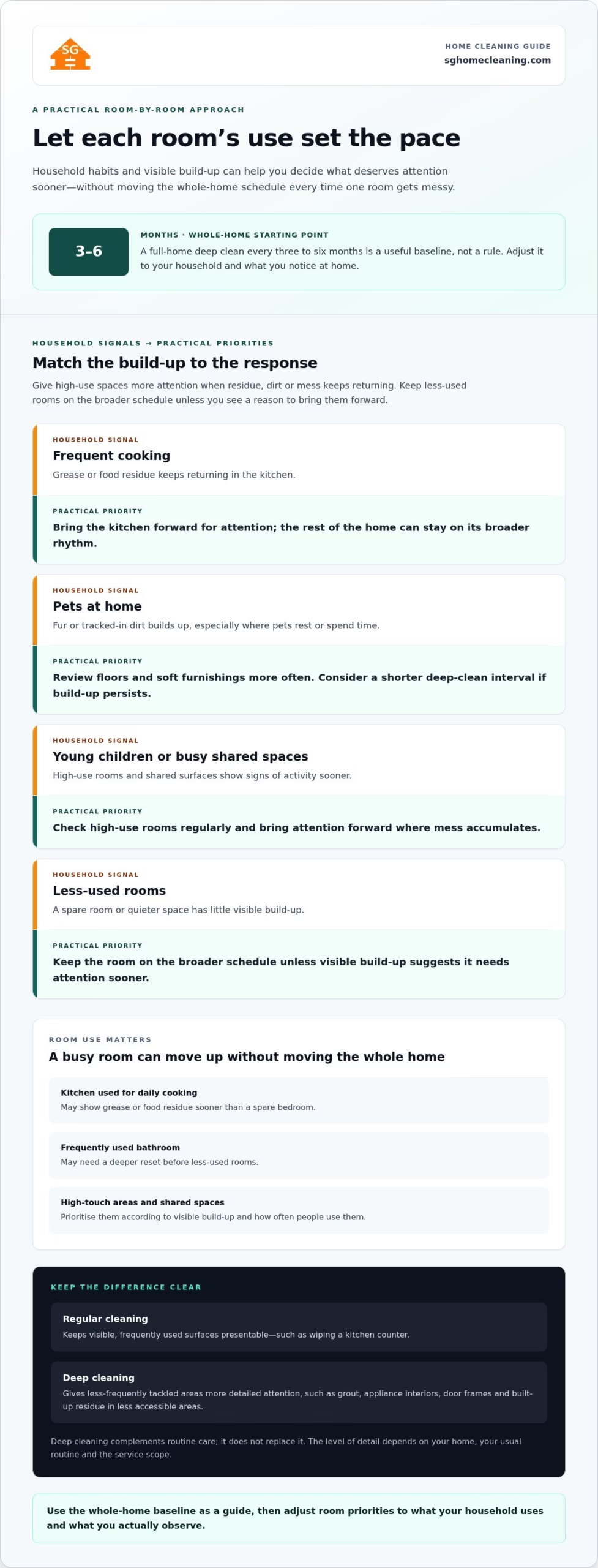
A kitchen used for daily cooking may show grease or food residue sooner than a spare bedroom. A frequently used bathroom may also need a deeper reset before less-used rooms. Prioritise high-touch areas and shared spaces according to visible build-up and how often people use them. A busy room can move up your schedule without bringing the whole home’s deep-clean date forward.
Use this comparison as a starting point, not a fixed timetable:
| Household circumstance | Practical schedule adjustment |
|---|---|
| Frequent cooking | Prioritise the kitchen sooner if grease or residue keeps returning. |
| Pets at home | Review floors and soft furnishings more often; consider a shorter deep-clean interval if build-up persists. |
| Young children or busy shared spaces | Check high-use rooms regularly and bring forward attention where mess accumulates. |
| Less-used rooms | Keep them on the broader schedule unless visible build-up suggests otherwise. |
When deciding how often should you deep clean your home, use these room-by-room signals to shape a plan you can revisit. If a full reset is difficult to fit in, a one-time home cleaning enquiry is a practical next step.
How to build a deep-cleaning schedule you can maintain
A useful calendar is one you can follow, not a list that turns every free day into a cleaning day. Start with the areas that need deeper attention, spread the work out and review the plan as your household changes. This makes it easier to decide how often should you deep clean your home without committing to an unrealistic routine.
A simple way to set and review your cleaning calendar
Use this four-step method to turn household priorities into manageable reminders:
- Assess how each space is used. List the rooms and mark the areas your household relies on most, such as a regularly used kitchen or shared living space.
- Identify what routine cleaning misses. Note the areas that tend to be postponed or are difficult to fit into everyday upkeep.
- Set priorities and spread them out. Choose a date for a whole-home reset, then put smaller tasks on separate reminders instead of scheduling everything together.
- Review and adjust. Revisit the calendar after a busy period, a change in household size or noticeable build-up. Move tasks forward or back based on what you see.
Keep the distinction clear: a whole-home reset is a larger, periodic effort, while smaller deep-cleaning tasks can be spread across the calendar. For example, focus on one overlooked area between broader resets. A good deep-cleaning plan changes when your household’s routines, occupancy or home condition changes.
When one-time or weekly cleaning may fit your plan
If postponed tasks have accumulated or you’d prefer help with a more thorough reset, one-time house cleaning services can be part of your plan. For regular upkeep between deeper resets, a weekly cleaning service provides ongoing support. Weekly cleaning and deep cleaning serve different purposes, so treat them as complementary options rather than assuming routine upkeep covers every periodic task.
Keep the calendar flexible. A demanding stretch may make a reset harder to manage, while a change in household routines may make some tasks less urgent. Adjust the plan to fit your available time and the work your home needs, rather than trying to meet an inflexible schedule.
When to arrange a professional deep clean, and what to do next
You can keep up with routine cleaning yourself and bring in professional help when a larger reset would make the workload more manageable. The decision doesn’t have to depend on a particular date. Consider what has built up, what has changed at home and how much time you can realistically set aside.
Signs a professional reset may make sense
Consider a one-time deep clean if several areas have fallen behind at once or routine tasks no longer seem to catch up with the work you’ve postponed. A change in household size, a new routine or a busy period can also make it harder to maintain your usual schedule. These are useful signals to reassess your plan, not requirements to hire help.
List the areas you want addressed and separate them from tasks you’re comfortable handling yourself. Clear priorities help you decide whether you need support for a specific reset or would rather spread the work across your calendar.
Choosing between a one-time reset and ongoing upkeep
A one-time service suits a home that needs more thorough attention at a particular point. SG Home Cleaning offers one-time house cleaning for this kind of reset. Weekly cleaning supports regular household upkeep. It can help maintain a routine, but it doesn’t replace deeper cleaning needs that depend on your home and habits.
Before arranging a service, consider which areas you want prioritised and how they fit your household’s needs. SG Home Cleaning provides clear service scopes so customers know what a visit covers, and its cleaners are locally trained. If you’re researching service costs, consult the available deep cleaning price guidance as part of your planning.
Ultimately, how often should you deep clean your home depends on how you use it and what routine you can sustain. If a professional reset would help you get back on track, describe the cleaning support you’re looking for when you make an enquiry.
Set a routine that can flex with your home
Choose a starting point for your next deep clean, then treat it as a checkpoint rather than a fixed rule. Ask what has become harder to keep up with, which rooms need more attention and whether your available time has changed. A simple review can help you decide how often should you deep clean your home without letting a calendar dictate what your household needs.
If a larger reset would make your routine easier to manage, SG Home Cleaning offers online booking and quote requests for home cleaning. Share what kind of support you’re looking for and take the next step at a pace that suits your household.
A realistic plan doesn’t need to cover everything at once. Start with one manageable action, then adjust as your home and routines change. Build a cleaner, more comfortable rhythm one step at a time.
Frequently Asked Questions
Is there an official rule for how often a home should be deep cleaned?
No official universal timetable sets how often should you deep clean your home. A suggested interval is a planning guide, not a legal or health requirement. Choose a review date that fits your household, then adjust if use or build-up changes. For instance, a rarely used guest room may not need the same attention as a regularly used dining area. Focus on observed needs.
Does Singapore’s humid climate mean I should deep clean more often?
Not automatically. Humidity alone doesn’t determine how often a home needs a deep clean. Pay attention to conditions inside your home, such as persistent dampness, condensation or a musty smell, and consider the source rather than relying on cleaning alone. Keep rooms aired where practical and follow care instructions for surfaces and furnishings. If you’re unsure what’s causing ongoing moisture, seek appropriate building or maintenance advice.
How often should you deep clean a mattress?
There isn’t one interval that suits every mattress. Follow its care label, since materials and cleaning methods differ. Review its condition when changing bedding, and respond sooner to a spill, visible soiling or an odour. Avoid soaking the mattress or using a product that could damage its fabric or filling. If a stain or smell persists, check the manufacturer’s guidance before trying a stronger treatment.
Can I deep clean my home one room at a time?
Yes. A room-by-room approach can make a larger cleaning plan more manageable, especially if you have limited time. Choose one space, decide what needs attention and complete that area before moving on. Keep a simple note of rooms already handled so tasks aren’t accidentally repeated or forgotten. This approach works well for household-led cleaning, while a whole-home reset may suit you better if many areas need attention together.
Is deep cleaning the same as spring cleaning?
Not exactly. Spring cleaning usually describes a seasonal, more thorough household clean, while deep cleaning describes the level of detail involved. The two can overlap: you might use a seasonal clean as an occasion to give less frequently cleaned parts of the home deeper attention. Neither term requires a particular season or date. Choose a timing that fits your household rather than waiting for a specific annual event.
How long does a professional deep clean take?
There isn’t a single reliable duration for every professional deep clean. Time can vary with the home’s size, condition, areas included and number of cleaners. A regularly maintained home may need a different amount of work from one with several accumulated tasks. For a more useful estimate, describe the home and the cleaning scope when requesting a quote, and review what the service covers.